

Thermal Insulation and Fire Protection for Aircraft
From engine bays to cabin structures — ultra-thin thermal barriers that meet the most demanding aerospace fire-safety standards.
The challenge
Every gram counts — and fire containment is not optional.
Modern aircraft demand thermal insulation in the most weight- and space-constrained environments: engine bays, fuel tank surrounds, auxiliary power units, cabin walls. The right silica aerogel composites open new design possibilities — delivering high thermal performance at significantly reduced thickness and weight compared with conventional insulation systems.
Next-generation platforms — hybrid-electric and hydrogen-powered aircraft — introduce new thermal management challenges around battery packs, fuel cells, and cryogenic hydrogen storage. The insulation must perform across a wider temperature range, in thinner envelopes, while passing FAR 25.853.
How Skogar® solves it
Maximum thermal protection in minimum weight and thickness.
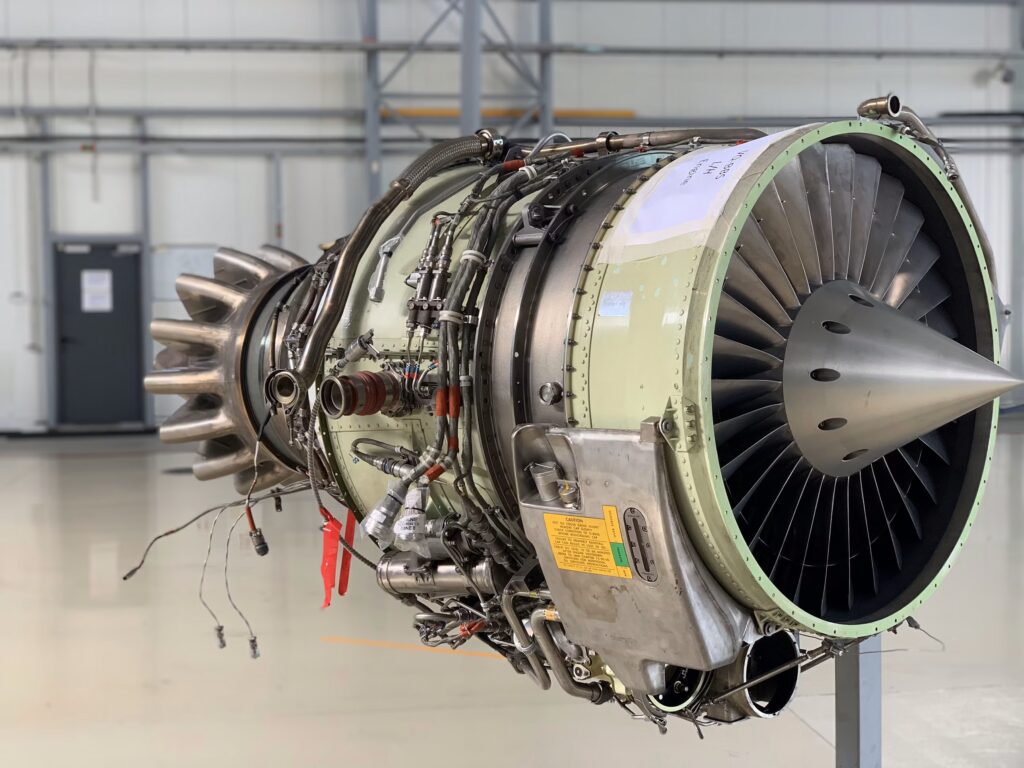
Engine bay & APU insulation
Skogar® HT, VHT, and UHT grades provide thermal and flame protection around engines and auxiliary power units — withstanding short-time flame exposure up to 1300 °C (HT), 1400 °C (VHT), and 1700 °C (UHT) while remaining flame-resistant and lightweight.
Fuel tank & cabin insulation
From 0.5 mm thick, Skogar® ST sheets insulate fuel tank surrounds and cabin walls with industry-leading thermal conductivity (0.012 W/(m·K)). Rigid and easy to cut.

Hybrid-electric & hydrogen platforms
Next-generation aircraft require thermal management around onboard battery packs, fuel cells, and cryogenic hydrogen tanks. Skogar® performs from −195 °C to +1700 °C — with different grades optimised for specific temperature environments.

Why aerospace engineers choose Skogar®
FAR 25.853
Skogar® HT is certified FAR 25.853 Appendix F — the reference fire-safety standard for commercial and transport aircraft.
From 0.5 mm · 130 kg/m³
Significantly thinner than conventional aerospace insulation at equivalent thermal performance. Direct weight and volume savings on every aircraft.
−195 °C to +1700 °C
One material family covering cryogenic hydrogen zones to engine-bay fire protection. May reduce integration complexity and material diversity.
🇫🇷 European supply chain
Manufactured in France. REACH compliant. EN 9100 targeted 2027-Q2. Short lead times, customs-free within the EU, direct technical support.
Recommended grades for aircraft applications
Each zone of the aircraft has different thermal and mechanical requirements. Skogar® offers a matching grade for every application.
Skogar® ST
Cabin, fuel tanks, structural insulation
Rigid glass fiber substrate. From 0.5 mm. Best choice where thin form-factor and structural integration matter most. 0.012–0.015 W/(m·K). UL94 V-0.
Skogar® HT ★
Engine bays, APU, fire zones — FAR 25.853
Flexible preox fiber substrate. From 2.0 mm. Certified FAR 25.853 Appendix F — the go-to grade for fire-rated aerospace applications. 0.012–0.018 W/(m·K). Up to 1300 °C.
Skogar® VHT & UHT
Extreme temperature zones
Semi-rigid, silica or ceramic fiber substrates. VHT up to 1400 °C, UHT up to 1700 °C. Both FAR 25.853 certified. For exhaust surrounds, APU enclosures, and turbine zones where HT’s 1300 °C ceiling isn’t enough.
Aircraft platforms and programmes
Commercial aviation
Engine nacelle insulation, cargo bay fire barriers, cabin wall thermal management. FAR 25.853 compliant solutions for OEMs and Tier 1 suppliers.
Hybrid-electric & eVTOL
Thermal management around onboard battery packs and electric propulsion systems. Ultra-thin barriers for weight-critical urban air mobility platforms.
Hydrogen-powered aircraft
Insulation for cryogenic hydrogen tanks and fuel cell thermal management. Skogar® is rated from −195 °C — one of the few thin-barrier materials capable of cryogenic service.
Evaluating thermal barriers for your aircraft programme?
Our engineering team supports grade selection, thermal modelling, and certification evidence for your specific airframe and operating conditions.